Which flagships belong here?
This comparison uses current premium models: Samsung’s high-end book foldable and Huawei’s flagship tri-fold. Availability is checked on Samsung’s US pages and Huawei’s China pages, not assumed for Vietnam. As of September 10, 2026, Samsung’s current lineup explicitly places Galaxy Z Fold8 Ultra above the newly reshaped Fold8. Its Fold8 Ultra product page calls the Ultra the continuation of the original Fold line. It is the relevant high-end Galaxy book foldable, rather than an older model chosen because its name is familiar.
There is a more exotic Samsung: Galaxy Z TriFold. Its 10-inch display and two hinges make it a closer format match for Huawei. But Samsung’s US TriFold page now says the limited run is completely sold out. We therefore use the current Fold8 Ultra as the primary buying comparison, while acknowledging that TriFold remains Samsung’s larger-screen engineering showcase. That is a US availability distinction, not a claim that no retailer anywhere has one.
Huawei takes the other route. Its China lineup leads with Mate XT 2 Ultimate Design, a tri-fold. For the highest configuration, this article uses the 16 GB/2 TB stylus bundle with the privacy inner display. Huawei’s specification sheet distinguishes it from the standard model: the standard inner screen reaches 90 Hz, whereas the privacy-display variants reach 120 Hz. Treating every Mate XT 2 as the same panel would miss an important difference.
Finally, iPhone Duo is announced, not yet a retail peer. Apple’s US page lists October 16 preorders and October 23 availability. This is consequently a technology and buying comparison, not a three-phone hands-on review. Apple’s new screen cannot already have a meaningful history of ordinary retail ownership.
Why a crease can seem to disappear
A foldable’s crease is not just a dark line drawn across an OLED. A slight change in the surface angle changes how room light reflects toward your eyes. A fold can be unobtrusive while you read bright content head-on, then become conspicuous when you tilt the same phone under a ceiling light. That is why a carefully lit product photograph cannot settle this contest.
There are three separate questions. Visual visibility concerns reflections and image distortion. Tactile depth is the dip or ridge your fingertip notices while crossing the folding region. Long-term behavior concerns what changes after use: the panel, its protective layer and the hinge need not age in the same way. Reducing glare may help the first without eliminating the second; neither establishes the third.
The hinge and screen stack also work together. The hinge guides the bending path, while the layers above it must accommodate that movement and return to a usable surface. A cover made from an impressive-sounding metal does not, by itself, reveal the bend radius, internal support geometry or residual groove depth. None of the official pages below supplies a common measurement that would let us rank all three for crease depth.
Apple: less glare, not proven crease-free
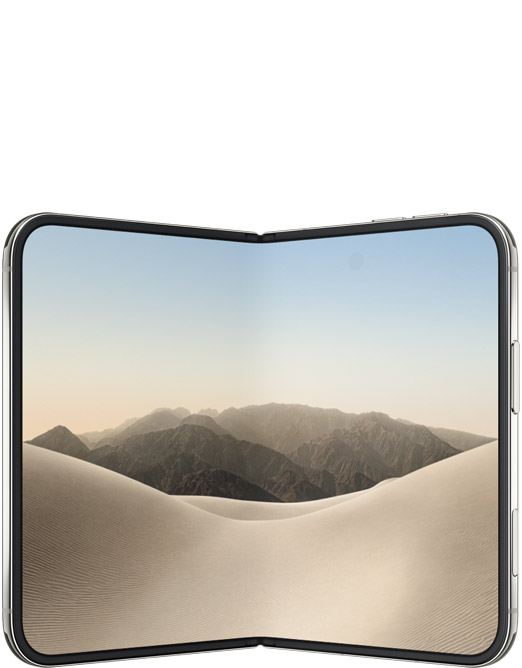
Image: Apple. Official promotional illustration of the folding design, not a matched crease test.
On its Duo product page, Apple describes the inner screen as 10 ultrathin layers with a custom nano-texture finish, producing a surface it calls “remarkably smooth and flat.” Its product page also specifies a scratch-resistant inner coating and a titanium frame and hinge cover. Those are useful construction details; they are not a published side-by-side crease test.
There is a mechanical claim as well as an optical one. Apple’s FAQ says optically clear adhesives let the display layers glide as the screen folds, minimizing stress and crease. That describes movement within the bonded screen stack, not just a treatment that hides reflected light. Apple does not publish a comparable residual-depth measurement or long-term crease result there.
The nano-texture is particularly relevant. If a crease bothers you mainly because a strip of reflected light follows it across the screen, reducing glare is a sensible design approach. It is still not evidence that your finger will feel no depression or that the display stays equally flat after months of folding. Apple’s public description does not provide enough hinge detail to assign it a specific internal mechanism or claim a superior bend radius.
Duo’s appeal is therefore straightforward: a larger iOS canvas with two-app Split View, rather than a promise that flexible glass has stopped behaving like a folding surface. The technical specifications list adaptive refresh up to 120 Hz on both screens. Apple Pencil USB-C support carries a “coming later this year” footnote; it should not be treated as a guaranteed launch-day advantage.
Samsung: support and reflections
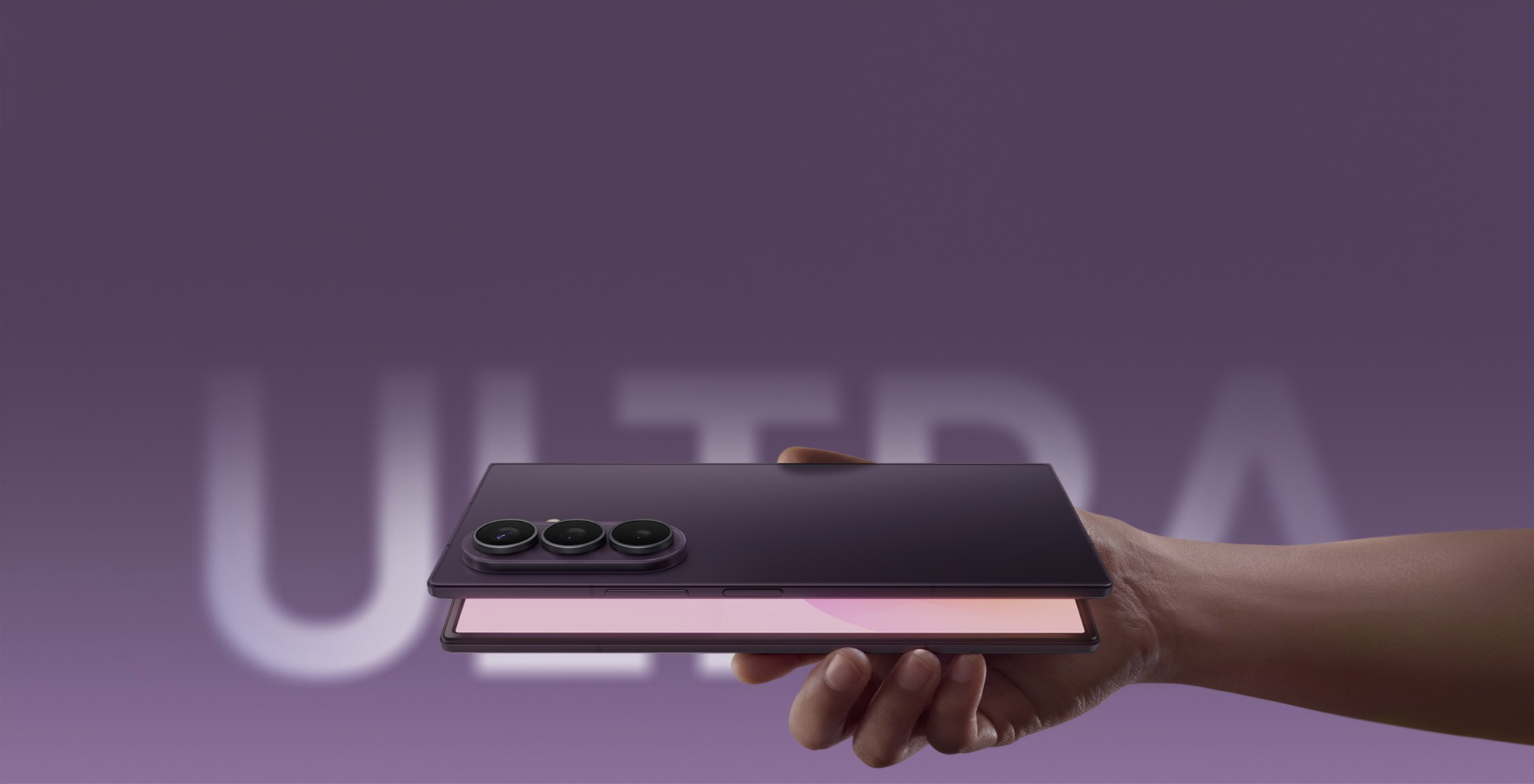
Image: Samsung. Official promotional illustration of the folding design, not a matched crease test.
Samsung describes Fold8 Ultra as combining an Armor FlexHinge with two titanium layers in the shock-absorbing structure beneath the display. It also adds anti-reflection to the main screen. The combination addresses different parts of the problem: support beneath the panel and distracting light above it. Samsung’s FAQ also describes a thinner, narrower hinge with reduced friction while retaining the overall hinge design. Neither the metal layers nor that refinement establishes a numerical advantage in crease depth.
There is another, smaller change worth noticing: Samsung describes a beveled inner bezel and a wider opening gap to make the phone easier to open. Ease of getting your fingers between the halves is not the same thing as a less visible crease. It can still make a daily difference if you open the phone repeatedly to read or work.
Owner reports on Samsung’s product page are encouraging but limited evidence. FrontierAJL’s August 27 review says the inner screen sits flatter and the crease is less noticeable; Andrew’s August 18 review also welcomes the crease improvement but dislikes interface changes and feels the device is too thin. Both entries are marked incentivised. These are individual reports hosted by the seller, not an independent consensus or a comparison with Duo and XT 2.
That distinction matters because an attractive “nearly invisible” headline can hide different lighting, different starting phones and different expectations. Samsung earns a place at the top of the everyday shortlist for its current availability, lower weight and single-fold design—not a verified trophy for the shallowest groove. Its FAQ also says S Pen is not supported, so a flatter-looking canvas does not turn this model into a pen tablet.
Huawei: a bigger canvas, two folds
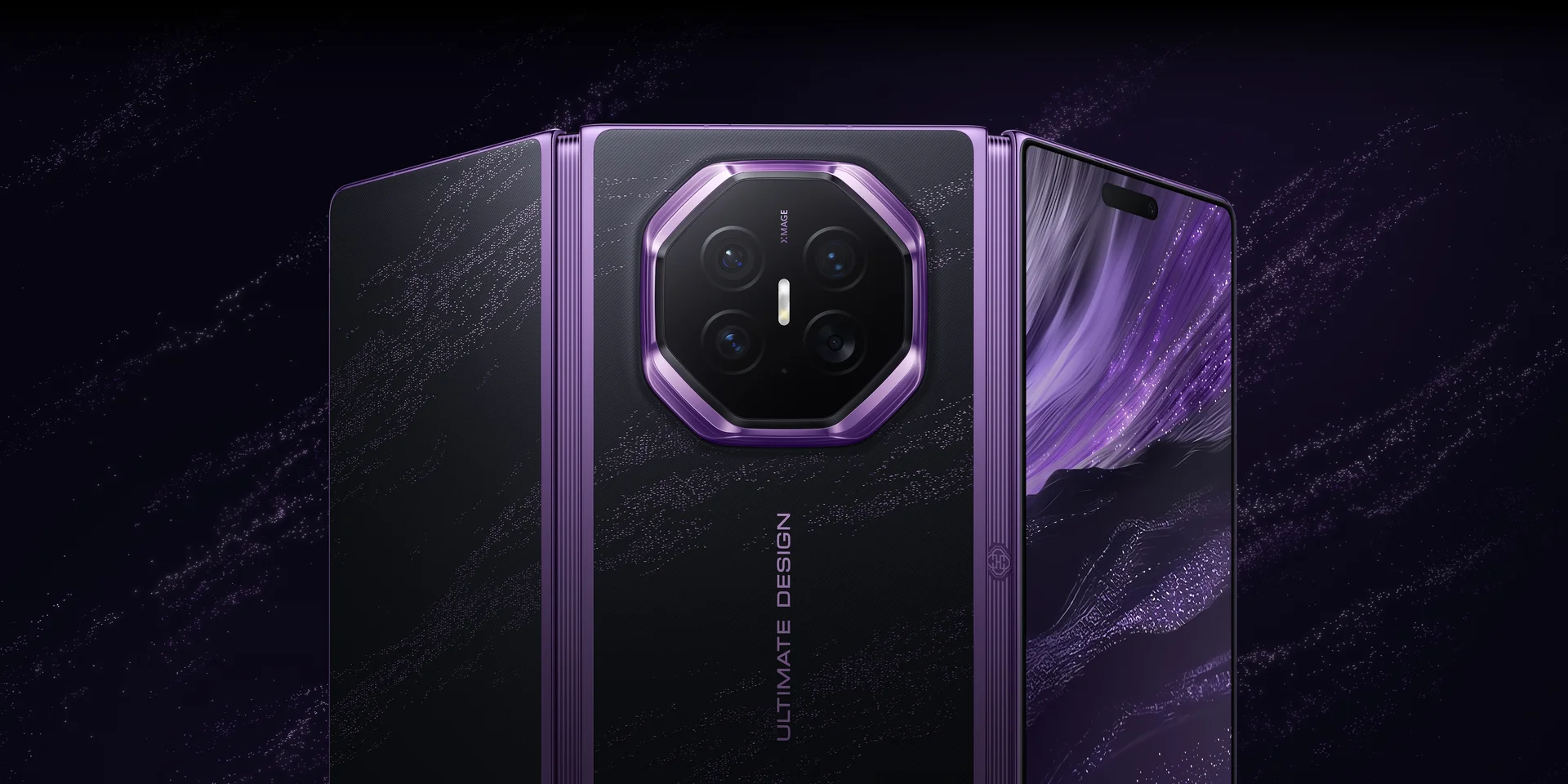
Image: Huawei. Official promotional illustration of the folding design, not a matched crease test. The image does not establish storage capacity or the privacy-screen bundle.
The Mate XT 2 product page describes a second-generation hinge system with a gearless synchronized linkage, alongside a multilayer flexible inner screen using UTG and an ultrathin high-strength steel cushioning layer. Huawei also describes a five-arc-arm main shaft intended to distribute force evenly. These are manufacturer explanations of the mechanism, not measurements of how flat the screen stays. Huawei’s impact-resistance improvement claims compare specified constructions under its own conditions. They cannot be converted into “more durable than Apple or Samsung.”
The tri-fold’s attraction is the working area. A document, a reference page and a conversation have more room on a tablet-sized canvas. The cost is two folding regions rather than one, more weight, and a prescribed closing sequence. Huawei instructs owners to fold the side without the volume buttons first and warns that the wrong order can damage the device. This is not just a larger book foldable that you can close any way you like.
Crucially, Huawei itself says creases and unevenness in the bending regions are normal. It also warns against pressing hard around precision components and against removing or adding to the inner protective film yourself. Those instructions are more useful to a prospective owner than a promotional frame in which the screen looks perfectly flat.
The top privacy display introduces another distinction. Restricting the viewing angle to protect private content is not a crease-removal technology. Huawei says the USB-port direction is not protected by that privacy effect. Any screen comparison should therefore state whether privacy mode is on and from which side it is viewed. Otherwise, intentional off-axis dimming can be confused with a display defect or with better suppression of a crease reflection.
What the evidence can actually settle
For now, the strongest comparison is of design choices, not a scored crease ranking. Apple combines surface optics with a claim that adhesive layers allow the screen stack to glide; Samsung combines anti-reflection with reinforced support; Huawei stretches the concept into a much larger two-hinge device and offers a distinct privacy-panel configuration.
No matched independent three-way crease assessment is established here. The owner comments above are useful anecdotes, but they do not fill that gap. In particular, they cannot establish how the announced iPhone will compare after equivalent use. There is no basis to quote a numerical crease reduction, declare a universally invisible fold or name a long-term durability winner.
How to judge one before buying
When demo units are available, compare them under the same light, with similar brightness and identical content. Start with a white reading page, then dark content, then a screen-off reflection. Look straight on and slowly tilt each phone so the same light crosses the folding region. Inspect both folds on Huawei rather than finding one favorable camera angle.
Next, gently move the pad of a finger across the screen as you would when scrolling; do not press with a nail or try to flatten it. This separates the groove you feel from the reflection you see. If you plan to write or draw, check the exact supported stylus and screen configuration rather than assuming that every large foldable supports a pen.
Finally, ask whether the unit is new or has spent weeks on display. A demo with unknown wear is not a controlled longevity test, but its condition can still help you decide whether the trade-off bothers you. The useful question is whether you notice the fold in your own work—not whether you can force it to appear under a spotlight.
Ownership still breaks the tie
An ingress rating does not measure hinge fatigue or resistance to a fingernail. Apple’s IP68, Samsung’s IP48 and Huawei’s IP58/IP59 describe different protection categories and test conditions, not a universal ladder of foldable durability. Check accidental-damage coverage and inner-screen repair terms where you actually live. Huawei’s China service benefits should not be assumed to transfer to an imported device in Vietnam. The body-thickness figures below are not a complete measure of bulk: Huawei explicitly excludes the screen bezels and, in the relevant section, the camera module.
The same restraint applies to price. Samsung’s US page lists Fold8 Ultra from $2,099.99 before trade-in; Huawei advertises Mate XT 2 from CNY 19,999, but that is a range starting price, not a quotation for the 2 TB privacy-screen stylus bundle. These September 10 figures cover different configurations, currencies and markets. Neither is a Vietnam landed-cost comparison.
If your existing workflow is Apple-centered, wait for Duo’s retail screen and touch it before buying on the strength of “smooth and flat.” If you want a premium everyday foldable now, Fold8 Ultra is the sensible first demo. If replacing more of a tablet is the goal, the top Mate XT 2 deserves attention—but only after checking the exact HarmonyOS apps, local connectivity and repair arrangements you need. The largest screen can be the right flagship without having to win an unsupported crease contest.
Sources
- Apple: iPhone Duo design, display and launch schedule
- Apple: iPhone Duo technical specifications and feature footnotes
- Samsung: current Galaxy smartphone lineup
- Samsung: Galaxy Z Fold8 Ultra construction, FAQ and dated owner reviews
- Samsung: Galaxy Z TriFold and sold-out US status
- Huawei: current China smartphone lineup
- Huawei: Mate XT 2 design, handling instructions and service notes
- Huawei: Mate XT 2 specifications by display and storage configuration